
The Future of District Heating
The Future of District Heating
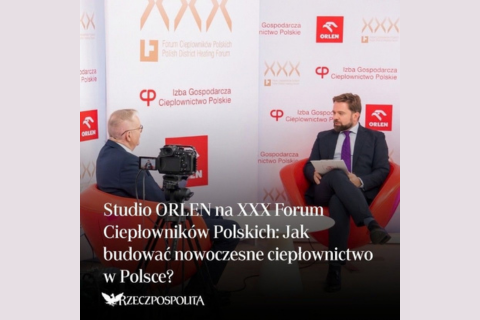
4CF at the XXX Polish District Heating Forum
The future of Polish district heating is being forged today, and the time horizon for adaptation is shrinking rapidly. During the jubilee XXX Polish District Heating Forum in Międzyzdroje, Kacper Nosarzewski, Partner at 4CF The Futures Literacy Company, led a series of key conversations in the ORLEN Studio with decision-makers, regulators, and company representatives about how to design the future of the industry that heats over half of Polish homes.
A consistent, though challenging, picture of the coming decades emerges from the discussions. Here are the most important conclusions from these meetings:
- A buffer for the power system: District heating is no longer an isolated island but is becoming a key buffer for the entire power system. Electrification (e.g., large-scale heat pumps and electrode boilers) will allow the consumption of surplus “cheap” energy from renewables during periods of oversupply. District heating will gain a new role as a grid stabilizer.
- No one-size-fits-all solution: In the context of the transformation, there is no single universal solution. For many companies, especially those moving away from coal, gas is becoming a guarantor of security and business stability. Cogeneration not only allows for heat production but also gives companies new earning opportunities on the electricity trading market, increasing their profitability during the difficult transition period.
- Tailored local mixes: What works in large agglomerations will not be optimal for smaller municipal systems. The future for the latter lies in building diversified, local mixes modeled on the Scandinavian approach—combining biogas, biomass, waste heat, and geothermal energy.
- Accelerating timelines and investments: Time is radically accelerating. The end of 2028 will bring restrictive efficiency requirements under the EU’s RED III directive. The biggest strategic challenge will be balancing massive capital expenditures (estimated at hundreds of billions of zlotys by 2050) with tariff rates that must remain socially acceptable. New tools, such as the District Heating Transformation Fund (3 billion PLN), are a step in the right direction but still require better synchronization with the government’s strategic goals.
There is no single, universal model for district heating transformation. The companies that will survive are those that bet on technological flexibility, long-term risk anticipation, and a bold shift in their business model—from simple heat providers to active players in the integrated energy market.
Stay updated! Subscribe to our newsletter:
By subscribing to our newsletter, you consent to the processing of the provided data. The data controller is 4CF Sp. z o.o., its registered office is located in Warsaw, 10/14 Trzech Krzyży Square, postal code: 00-499.
We process your data solely for the purpose of sending information about 4CF Sp. z o.o. and its activities via e-mail. Your data will be processed until your consent is revoked through a link that will be included in each newsletter. The withdrawal of consent shall not affect the lawfulness of processing based on consent before its withdrawal. Providing your data is voluntary, but necessary if you wish to receive information about 4CF Sp. z o.o. and its activities. We may transfer the data to our suppliers of services related to the processing of personal data, e.g. IT service providers. Such entities process data on the basis of a contract with our company and only in accordance with our instructions. You have the right to request access to your personal data, its rectification, deletion or limitation of processing, as well as the right to lodge a complaint with the supervisory authority. More information about your rights and about the processing of your personal data can be found in our privacy policy.